



For years, Big Cable hid behind a curtain of marketing tricks. It’s time to pull the curtain back.
If you’ve seen the recent ads for “fiber-powered” internet, you’re watching one of the most successful (and most misleading) rebrands in tech history. The word doing all the heavy lifting in those ads is also the word doing all the lying.
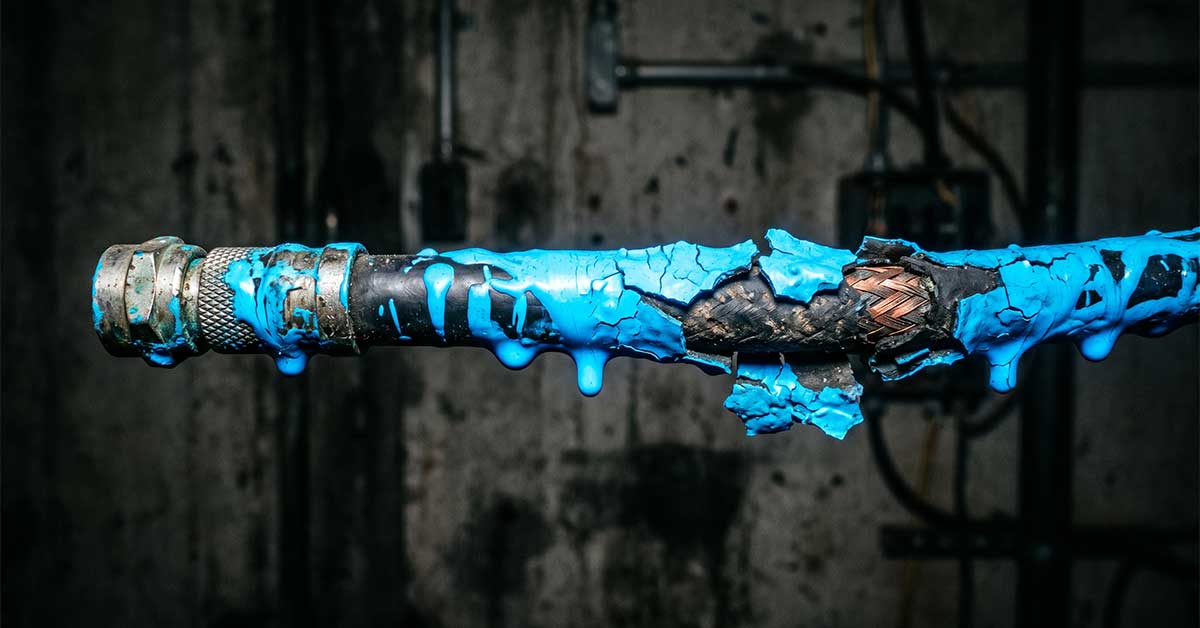
Let’s be honest. “Fiber-powered” is not fiber. It’s a fresh coat of paint on a crumbling copper network. While true fiber providers are out digging trenches and pulling glass into people’s living rooms, the cable giants are slapping the word “fiber” on the same hardware they’ve been running since the early 90s and hoping nobody notices.
The Great Copper Deception
Big Cable wants you to believe their network is new. It isn’t. What they’re calling “fiber-powered” is actually Hybrid Fiber-Coaxial, or HFC. Yes, they use fiber in the backbone of their network. So does every gas station, library, and McDonald’s in America. That isn’t a feature. That’s the bare minimum for running anything on the modern internet.
The problem lives in something called the last mile. That’s the stretch of cable that runs from the street into your living room. On a “fiber-powered” network, that last mile is still a thick coaxial copper line. Copper is the enemy of modern internet. It’s vulnerable to weather. It picks up interference. And no matter how much fiber sits behind it, copper is physically incapable of matching the performance of a real fiber connection.
Run fiber to the corner, hand it off to ancient copper, then call the whole thing “fiber-powered.” That’s not fiber internet, that’s just cable internet rebranded.
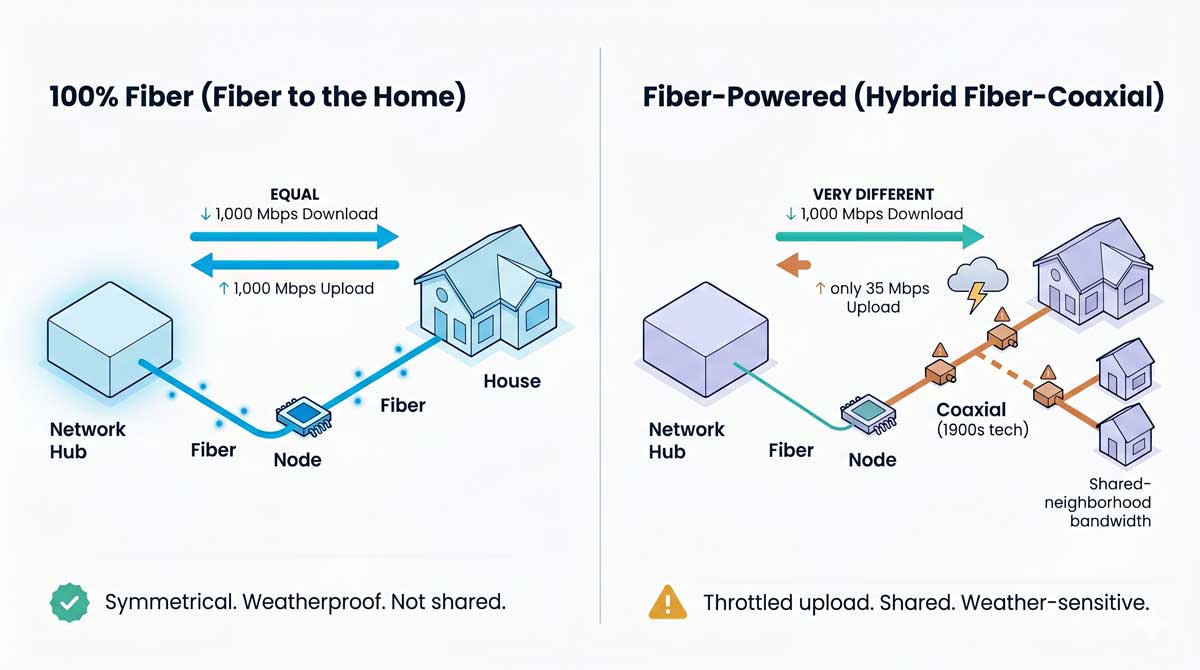
“Fiber-Powered” vs. 100% Fiber, Side by Side
| "Fiber-Powered" Cable (HFC) | GigabitNow 100% Fiber (FTTH) | |
|---|---|---|
| What Enters Your House | "Fiber-Powered" Cable (HFC): Old coaxial copper cable | GigabitNow 100% Fiber (FTTH): Fiber-optic glass |
| Upload Speed | "Fiber-Powered" Cable (HFC): Throttled (often 20–100 Mbps) | GigabitNow 100% Fiber (FTTH): Symmetrical, matches download |
| Peak-hour Performance | "Fiber-Powered" Cable (HFC): Slows down (shared with neighbors) | GigabitNow 100% Fiber (FTTH): Holds steady |
| Reliability in Storms | "Fiber-Powered" Cable (HFC): Degrades, drops out | GigabitNow 100% Fiber (FTTH): Unaffected by weather |
| Underlying Tech Age | "Fiber-Powered" Cable (HFC): 1990s coaxial | GigabitNow 100% Fiber (FTTH): Current generation fiber-optic |
| Marketing Language | "Fiber-Powered" Cable (HFC): fiber-powered, powered by fiber | GigabitNow 100% Fiber (FTTH): fiber to the home, 100% fiber, FTTH |
Why They’re Lying to You Now
Why the sudden obsession with the word “fiber”?
Pressure.
For decades, cable companies enjoyed a cozy near-monopoly in most markets. They didn’t have to innovate, because you didn’t have anywhere else to go. They raised prices. They got worse at customer service. They kept billing you for old hardware and calling it new.
Then real fiber providers like GigabitNow started showing up in their territory.
Fiber networks deliver symmetrical speeds. Your upload matches your download, which matters more every year as life moves to video calls, cloud storage, working from home, and security cameras streaming footage all day. A 35 Mbps upload was acceptable in 2008. In 2026, it’s a joke. The cable companies know it. They’re terrified you’re going to figure it out.
So instead of doing the expensive, multi-decade work of replacing all that copper with glass, they did the cheap thing. They went to their marketing department. Called it fiber-powered. Put the word “fiber” in the logo. Run ads about fiber. Hope nobody asks the follow-up question.
How to Spot the Rebrand
You don’t have to be a network engineer to catch them. Three quick checks will do it.
Check the upload speed. If the ad screams about gigabit download and the upload number is buried in the fine print at a fraction of that, you’re being sold copper. True fiber to the home is symmetrical, or very close to it.
Check the words. “Fiber-powered.” “Powered by fiber.” “Fiber-rich network.” Those phrases describe the backbone of the network, not the line into your house. The phrases that describe what you actually want are “fiber to the home,” “FTTH,” and “100% fiber.” Notice which providers refuse to use those phrases.
Check the wall. If the cable plugged into your wall is the thick screw-on coaxial line that’s been used for cable TV since the 1990s, you’re on copper, and the fiber the provider is bragging about stops well short of your living room.
If you fail two of those three checks, you’re paying premium prices for technology from the 1900s.
It’s Always Been This Way
This isn’t a new tactic for Big Cable. They have a long history of innovating in the marketing department instead of the engineering lab. It’s cheaper to convince you that aging infrastructure is “state of the art” than to actually replace it.
They’re betting on a few things. They’re betting you won’t read the fine print. They’re betting the word “gigabit” will dazzle you enough that you won’t ask what’s running underneath it. They’re betting that the difference between “fiber-powered” and “fiber to the home” is too technical for you to care about.
They’re wrong on all of it.
Stop Paying for The Marketing Budget
Don’t be the punchline of a rebrand campaign. If the cable coming into your house is a screw-on coaxial connector, you’re being sold a legacy service at premium prices, with the word “fiber” sprinkled on top to keep you from looking elsewhere.
GigabitNow isn’t “powered by” fiber. It is fiber. The glass runs all the way in, not to a box on the corner and then through copper that’s older than most of the people relying on it. Symmetrical gigabit speeds. No weather drops. No peak-hour slump. No marketing asterisk.
The era of the copper monopoly is over. Check availability with GigabitNow and stop paying Big Cable to lie to you.
Published: April 22, 2026